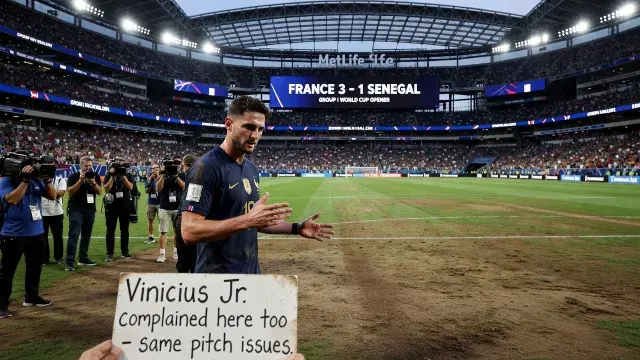
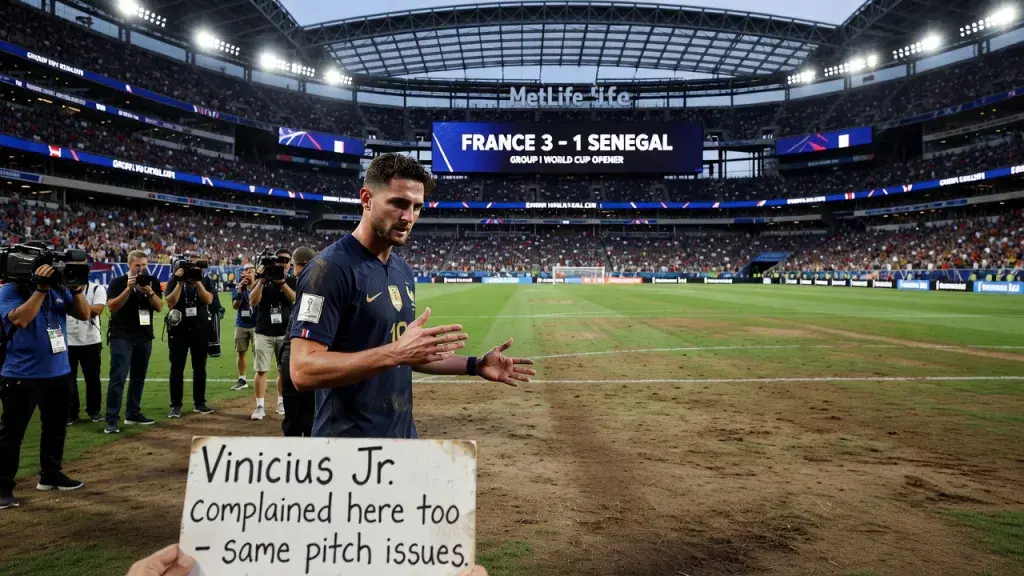
Adrien Rabiot did not spare his words after the final whistle at MetLife Stadium on Tuesday. The French midfielder, who played every minute of France's 3-1 opening Group I victory over Senegal, told reporters post-match that the playing surface felt alarmingly close to artificial turf - rigid underfoot, unresponsive, and unworthy of a World Cup stage. France had won comfortably, but Rabiot made clear the result had done little to ease his concern about the conditions.
His frustration lands in already troubled territory. Just days earlier on Saturday, Brazilian forward Vinicius Junior raised similar alarms after the Seleção were held to a 1-1 draw by Morocco at the same venue, pointing to an excessively dry and hardened surface that he said slowed the ball and strangled attacking play. When two of the tournament's most prominent stars, representing two of global football's most scrutinised markets, independently flag the same problem at the same ground within the space of a few days, the pattern is impossible to dismiss - regardless of the sport, whether you follow the full-contact chaos of live futsal bets or the refined technical demands of the international game at its highest level. live futsal bets
MetLife Stadium, sitting just across the Hudson River from Manhattan in East Rutherford, New Jersey, is scheduled to host eight matches in this expanded tournament. That figure alone would be enough to put the ground under intense scrutiny - but the stakes run considerably higher. The stadium is the designated venue for the World Cup final on 19 July. Elite players are already complaining during the group stages. That leaves groundskeeping staff and tournament organisers with a narrowing window and no room for complacency.
A Problem That Has History Behind It
The pitch debate at MetLife is not occurring in isolation. It echoes one of the more uncomfortable controversies from World Cup 2014, when the playing surface at the Arena da Amazônia in Manaus - host to England's group stage fixture against Italy - was so visibly parched and degraded that it was reportedly sprayed with green dye ahead of kick-off to maintain an acceptable appearance on international broadcasts. Players from both sides noted the unforgiving hardness of the ground, which limited their technical expression and, in their view, raised the risk of muscular injury. The optics were poor and the football reflected the conditions.
The parallels with the current situation in New Jersey are uncomfortable for FIFA and for the tournament's American hosts. Unlike Manaus - where extreme Amazonian heat and humidity offered at least a climatic explanation - MetLife is an indoor-style stadium with a retractable roof, a controlled environment, and no comparable excuse for a substandard surface. The expectation of a venue of that scale, hosting a final of this magnitude, is considerably higher.
What This Means Going Forward
Rabiot's complaint carries weight precisely because it is measured rather than theatrical. He is not a player given to public grievances. His point - that the surface barely qualified as proper football grass - raises legitimate questions about how the turf has been maintained during the tournament's opening phase and how quickly remedial work can take effect without disrupting the fixture schedule.
For France, the result matters far more in the immediate term. Three points against Senegal provides a stable foundation in Group I. But if the pitch continues to degrade, the cumulative effect on passing rhythm, injury exposure, and player confidence will become a factor that goes well beyond individual frustration. Tournament organisers have been put on notice. Whether they act decisively before the competition's most important match arrives will say a great deal about how seriously they take the players' legitimate concerns.