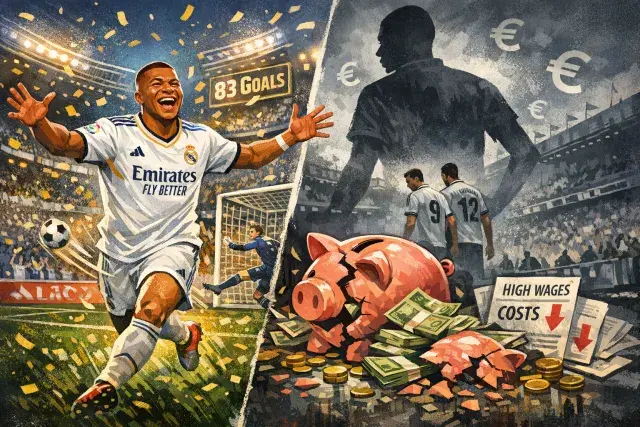
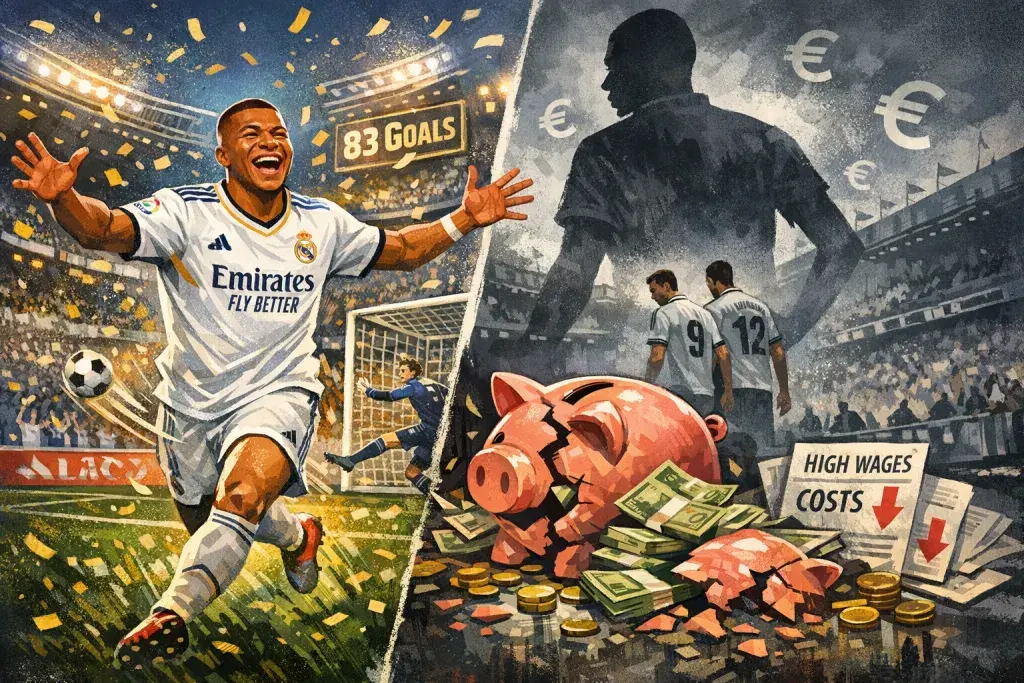
Eighty-three goals across 97 appearances is a number that commands respect in any context. Kylian Mbappe arrived at Real Madrid on a free transfer in the summer of 2024 and has produced, by the narrowest measure of individual output, exactly what was expected of him. But football — even filtered through the most generous lens — is not a solo discipline, and the broader accounting of Mbappe's two years in Madrid tells a considerably more complicated story.
The Numbers That Flatter and the Numbers That Don't
Mbappe's current tally of 39 goals across all competitions this campaign places him second in Europe's top five leagues, behind only Harry Kane at Bayern Munich. In the first half of the season, he was genuinely close to unplayable: 27 goals before the winter break, including four in a single Champions League fixture against Olympiacos and the opener in a 2-1 Clásico victory over Barcelona in October that briefly gave Real a five-point cushion at the top of La Liga. Comparisons to Cristiano Ronaldo, the Bernabéu's most decorated icon, were being made without irony.
Then came the second half of the season, and with it a collapse in both personal and collective form that has stripped those earlier numbers of some of their lustre. Mbappe has registered a single goal across his last seven outings for the club. His shot conversion rate for the campaign, which had been running at 25 percent, has fallen to four percent over that same stretch, according to Diario AS. In a 1-1 draw with Girona at the Bernabéu, he produced an expected goals on target figure of just 0.14, surrendered possession 20 times, and won fewer than a quarter of his ground duels. These are not the statistics of a man carrying his side.
The Structural Problem Mbappe Creates
The more revealing data point is not what happens when Mbappe performs poorly — it is what happens when he is absent. During a period in late February and March when Mbappe was sidelined with a knee sprain, Real won six of seven fixtures, eliminating Benfica and Manchester City from the Champions League and registering a convincing league victory over Elche. Manager Álvaro Arbeloa shifted from a 4-3-3 to a 4-4-2 system with Vinícius Júnior and Brahim Díaz leading the line. The side looked balanced, purposeful, and genuinely dangerous from multiple angles. Vinícius, who had been marginalised for much of the campaign, rediscovered the form that made him one of the world's most feared forwards in 2023-24.
When Mbappe returned, Arbeloa reverted to the previous system, and Real collected one point from two fixtures. The inference is uncomfortable but difficult to avoid: Real Madrid, one of the most historically successful clubs in European football, function better without their highest-profile asset on the field. That is not an argument against Mbappe's talent. It is an argument against the way his talent is being accommodated — at the expense of every other mechanism that made this club formidable.
There is a historical precedent worth examining. PSG, the club Mbappe left to join Real, did not win their first Champions League title until after his departure. During his final seasons in Paris, Mbappe's presence created a similar gravitational distortion — the entire attacking structure orbiting around one individual, making the collective unit brittle and one-dimensional. Ousmane Dembélé, written off as a chronic underachiever during his time at Barcelona, subsequently became a relentless pressing force and a Ballon d'Or winner as PSG's lead forward under Luis Enrique. The difference in approach — collective versus individual — was the deciding variable.
The Ego Beneath the Excellence
Mbappe is 27 years old and has still not won either the Champions League or the Ballon d'Or. Both absences point to the same underlying issue. His extraordinary goal-scoring ability is not in question; his willingness to subordinate his instincts to collective need very much is. Luis Enrique, who managed him at PSG, used a pointed analogy about Michael Jordan's defensive intensity to make the point. The implicit message was that elite performers in any discipline are defined not just by what they produce in their best moments, but by the standard they hold themselves to when the ball — or the focus — is elsewhere.
Mbappe addressed this directly during the March international break, telling The Bridge podcast: "I'm a player who defends a little less than others, and sometimes that can be a problem. It's true that I do it less, but I notice that when I do, it really impacts the team." The honesty is notable. The lack of urgency to change is more notable still. Self-awareness, without corresponding adjustment, is not a virtue — it is a sophisticated form of excuse-making.
What Real Madrid Must Reckon With
Barcelona now lead La Liga by nine points with seven fixtures remaining, and Real face a steep path to the Champions League semi-finals after losing the home leg of their last-eight tie against Bayern Munich 2-1. These are the tangible consequences of structural dysfunction. Real have gone backwards since Mbappe arrived — and the hardest part of that truth is that his goal tally makes it easy to pretend otherwise.
The club faces a decision that is less about tactics than about institutional courage. Mbappe's contract, his market value, and his status as the most prominent name in world football make him very difficult to accommodate differently and even harder to move on from. But the evidence of the past two seasons suggests that managing around his ego — rather than managing it — is a slow-acting poison. Barcelona's rise to dominance has not been accidental. It has been built on cohesion, defensive responsibility, and the absence of a structure that defers to one man regardless of context.
Real Madrid built a record-extending 15th European title on exactly those same principles, before abandoning them. Recovering them will require honesty about what Mbappe's presence actually demands — not from his talent, but from everyone around it.